
ADHD Therapy
The Anti-Fix Alignment Approach
TM
An ADHD-affirming therapy approach focused on understanding yourself and designing a life that fits
Who is this for?
Women with ADHD or AuDHD:
-
Newly diagnosed, self-identified, or exploring ADHD or AuDHD
-
Diagnosed or known for a while but sensing there’s more
How may this help?
-
Understanding of why life has felt hard (without it being your fault)
-
A map of your ADHD profile, needs, patterns so you can build a life that fits
-
Practical changes to work, home, relationships, and daily systems
-
Support to stop working against your own brain
-
More ease - not perfection, but genuine workability
-
A repeatable process you can return to for life

What makes this different?
Specialist Focus
ADHD in Women
Lived AuDHD Experience
25 Years Clinical
& Research
Original
Anti-Fix Alignment Approach
TM
TM

Why work with me?
I genuinely want to get to know you - what’s shaped you, and what you want - so together we can design you a life that fits.
1.
I am AuDHD - so I get it!
2.
Women's ADHD specialist
3.
25 years experience in psychology
4.
Holistic approach (blending cutting-edge, evidence-based and ancient wisdom)
5.
Research background, neurodivergent pattern recognition and decades of experience mean I’m very good at recognising your patterns and what may be most helpful
I can also support you with:
-
Life Path & Major Life Decisions
-
Life Purpose Discovery & Sustainability
-
Overcoming Fears, Blocks & Self-Sabotage
-
Relationships
-
Parenting
-
Stress, Anxiety, Depression
-
Self-Esteem & Self-Love
-
High Sensitivity & Empathic Ability
-
Spirituality exploration
-
and lots more...
A lot of what feels like a personal failing to women with ADHD, is actually a completely understandable response to spending years in environments that didn't fit our brains, often without even knowing we had ADHD.


How to work together
1. Book a free 20-minute connection call to ask your questions and see if we're a good fit.
2. Intake form emailed to help me understand you before we meet
3. Initial session using the Alignment Snapshot to give your clarity and a plan
No lock-in: short- or longer-term, depending on your needs
Pace and focus decided together
Investment: $275 per session.
This includes: 60 minute session, interpretation of forms and questionnaires, a concise session summary sent via SMS, access to my Therapy Continuity System - planned mini-tasks and scheduled SMS reminders that support continuity and momentum between sessions, plus a weekly ADHD coaching text.
Private Health Fund Rebates: As a registered psychologist, most private health funds offer rebates. Depending on your extras cover, rebates are usually $60–70 per session, with top-level cover up to $110.
This might not be the right fit for you if... You're in crisis, your safety feels at risk, or you're having thoughts of suicide. Or if what you're navigating needs more specialised or intensive care than one-to-one ADHD sessions can provide on their own - for example, care from a team around you, or a service that focuses specifically on what you're going through. None of this is a reflection of you. These experiences deserve dedicated support, and your GP can help connect you with a service suited to what you need. If you ever feel unsafe or in crisis, please contact Lifeline on 13 11 14, or call 000 in an emergency. Wishing you the care and support you deserve.
The Anti-Fix Alignment Model
TM
The Anti-Fix Alignment Model shows how wellbeing is shaped by alignment within each area of your life, and between your inner and outer worlds.
At the centre is Alignment.
Alignment isn’t about perfection or productivity - it’s about fit. It’s a direction rather than a destination, something you return to and refine as your life changes.
Supporting alignment are two foundations:
Self-Awareness - understanding your needs, patterns, limits, values, and inner signals.
Self-Relationship - how you relate to yourself day to day, including how you listen inward, make decisions, and respond with trust, compassion, humour, and respect.
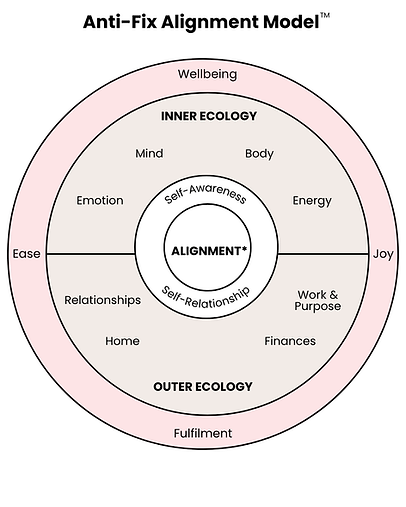
These foundations support your Inner Ecology - your mind, body, emotions, and energy - reflecting what’s happening inside you.
Your Outer Ecology reflects what’s happening around you: relationships, home, work and purpose, and finances. These are your Good-Fit Environments - conditions that can either support or drain your inner system.
Encircling everything is Wellbeing, experienced through Ease, Joy, and Fulfilment. These aren’t goals to chase - they’re signals that alignment is increasing.
When there’s misalignment, life feels effortful, even when you’re capable and insightful. As alignment grows, life doesn’t become perfect - but it can become easier. Energy lasts longer. Capacity shows up more consistently.
This model isn’t about fixing yourself. It’s about understanding where things fit, where they don’t, and redesigning from there.
The Anti-Fix Formula
TM
The Anti-Fix Alignment Model is the map. The Anti-Fix Alignment Formula is the method. We apply the Anti-Fix Alignment Formula in each area of your life. There are 4 stages.

The What - We slow down and notice what’s actually happening, inside you and around you. We pay attention to friction and flow, energy, emotions, body signals, and patterns - without judgement or trying to fix anything yet.

The Why - We get curious about what's actually driving the friction or flow - starting with what's around you (your environment, relationships, systems, and circumstances) and then what's happening inside you (your ADHD profile, needs, patterns, capacity, and beliefs).

The How - Based on what you now understand, we explore what could work better. This is a creative, pressure-free stage where we design options that reduce friction and support more ease, both internally and externally

The Lived Practice - You gently bring these designs into real life, noticing what supports flow and what gets in the way - with support, systems and accountability where it helps.
Foundations of the Anti-Fix Alignment Approach
This approach draws on over 25 years of combined clinical and research experience in psychology, alongside formal training, lived experience, and a dedicated focus on supporting women with ADHD.
You don’t need to read this to get started - it’s here for those who enjoy understanding the theory behind how things work Systems & Ecological Psychology Understanding wellbeing as emerging from the interaction between individuals and their environments - inner and outer ecologies, fit and misfit, and dynamic systems rather than isolated problems. Neurodiversity-Affirming & ADHD Psychology Grounded in contemporary ADHD research and the neurodiversity paradigm, focusing on strengths, needs, context, executive functioning, and sustainable supports rather than deficit or compliance models. Nervous System & Somatic Awareness Informed by trauma-aware, nervous-system-informed, and somatic approaches that recognise the impact of chronic stress, masking, and misfit environments on regulation, energy, and capacity. Parts-Based & Pattern-Oriented Approaches Drawing on parts-informed and schema-aware models to understand protective patterns, habits, and inner dynamics with curiosity and compassion rather than judgement. Cognitive, Behavioural & Narrative Models Integrating evidence-based cognitive, behavioural, and constructivist approaches to support awareness, meaning-making, small experiments, and real-world change. Values, Meaning & Existential Psychology Informed by humanistic, existential, and values-based frameworks that support identity, purpose, contribution, and fulfilment - especially during periods of transition or realignment. Behaviour Change & Self-Regulation Research Grounded in research on habit formation, self-monitoring, feedback loops, and implementation intentions, supporting realistic, low-pressure change over time. Integrative & Contextual Practice An integrative, evidence-based approach that draws selectively from multiple psychological traditions, applied within each person’s lived context rather than as a one-size-fits-all method.